Landscapes & Waves: A World Around a Cup
A landscape on porcelain asks you to keep looking. A stretch of water may lead toward a mountain; a small building may give a scene its scale. Because the image follows a curved surface, you discover it in sections. The vessel becomes a small world that opens as it turns.
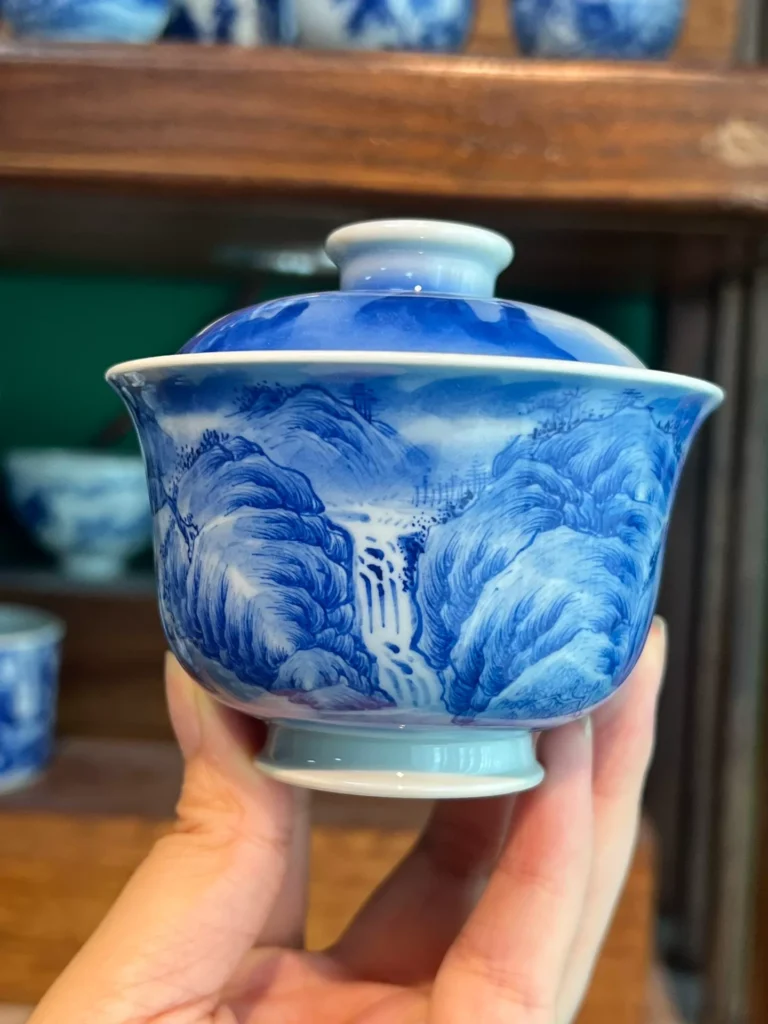
A landscape is more than a view
Chinese landscape art has a long history of artists responding to earlier works and transforming established ways of depicting nature. The Metropolitan Museum of Art’s Streams and Mountains without End exhibition describes how earlier painting styles became sources for later artists. This helps explain why a landscape can be an imaginative composition as well as a record of a place.
When looking at landscape porcelain, avoid assuming that a mountain or pavilion identifies a real location. Unless the maker or product information names it, begin with what is visible: the arrangement of land and water, the density of the marks, and the movement from one part of the scene to another.
Three things to notice
Depth. Compare large forms with small ones. A close tree, a distant ridge or a tiny building can give the eye a route into a compact picture. Look at whether the scene feels layered or deliberately flat and decorative.
Open space. Areas of undecorated porcelain can separate landforms and give the composition room to breathe. Depending on the scene, they may suggest distance, sky or water. Look for the relationship between these open areas and the darker passages rather than treating every white space as unfinished.
Continuity. A landscape may wrap around a cup or occupy separate framed areas. Explore the gallery to see how the composition changes beyond the main photograph. On a gaiwan, the lid introduces another surface that may repeat or complement the bowl’s scenery.
Waves bring a different rhythm
A wave pattern can be more immediate than a broad landscape. Repeated curls and lines create movement, while a rocky shape can interrupt that repetition. The contrast between flowing water and a firmer landform gives you a useful way to compare designs without needing to identify a particular historical pattern.
Our landscape grouping includes both scenic subjects and water-related decoration. It is a browsing family, rather than a claim that every piece tells the same story or comes from the same historical model.
Choose the atmosphere you enjoy
Start with Moonlit Landscape Gaiwan and Mountain Landscape Tea Cup. Compare the scene, its placement, and the form of each vessel. One photograph may draw your attention first, but the full gallery will show how the design works around the object.
For a tea setting, a scenic brewing vessel can provide the visual focus while simpler cups leave it room. Alternatively, one landscape cup can be a personal detail within a mixed collection. Check the dimensions and capacity before deciding: an expansive painted view can appear on a very small piece.
Compare pieces in this motif
These examples use the current product listings. Capacity is approximate; check the full contents and condition notes before choosing.
| Piece | Decoration | Listed capacity |
|---|---|---|
| Moonlit Landscape Gaiwan JDZ0019 | Blue & white | Gaiwan: 120 ml |
| Winter Landscape Gaiwan JDZ0025 | Blue & white | Gaiwan: 120 ml |
| Mountain Landscape Tea Cup JDZ0036 | Blue & white | Cup: 100 ml |
Choose a tea form · Understand capacity · Care and arrival checklist